
Hollow Oaths

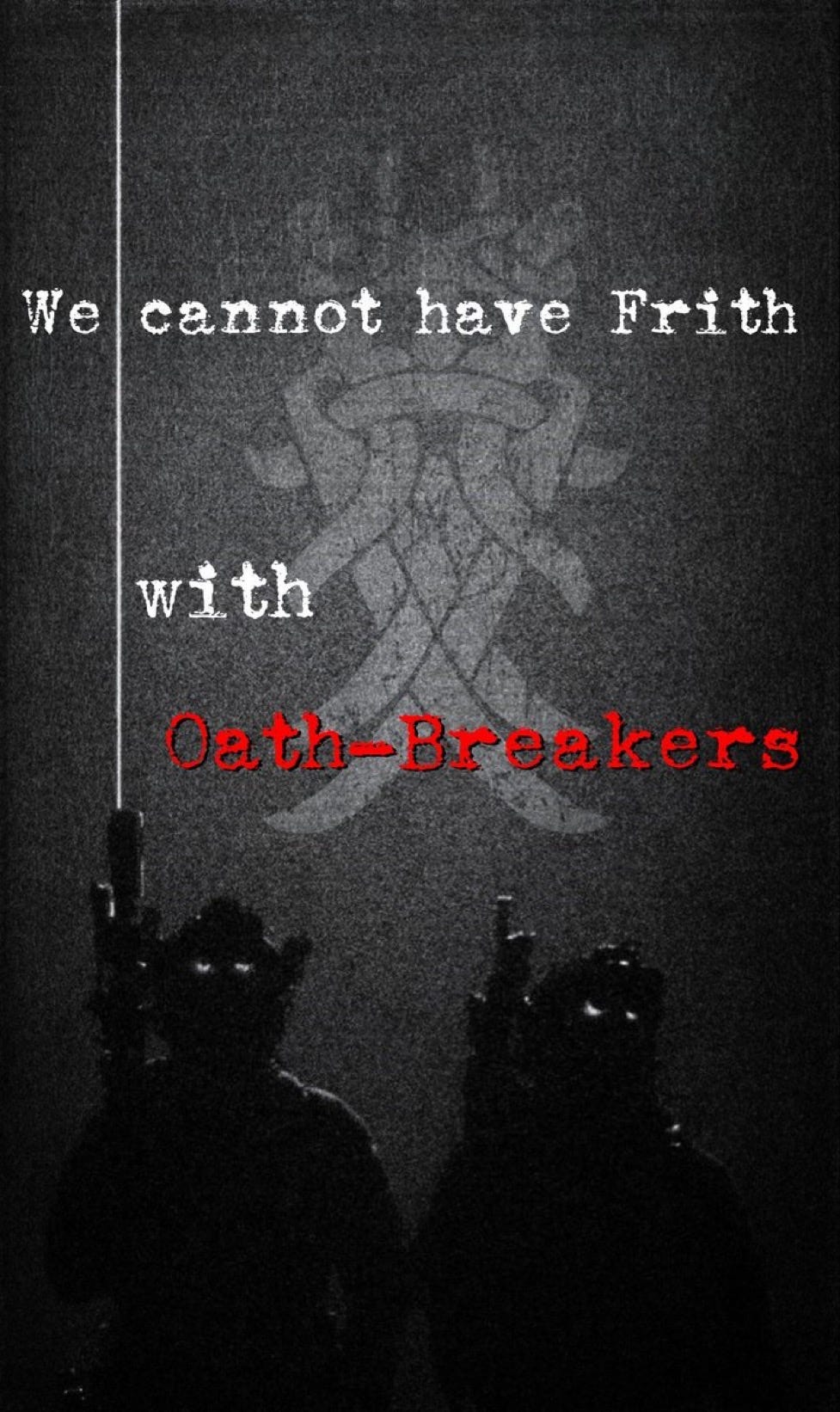
“A man’s word is his bond.” The phrase survives as a fossil, a relic from a time when words carried weight and breaking them carried cost. Today it is mouthed by men who mean nothing they say and face nothing for saying it.
Oaths were sacred. They were the bonds that held society together, the invisible chains linking a man to his word, his word to his honor, his honor to his standing among his people. To break an oath was to sever yourself from your tribe, to become something less than a man.
Now oaths are nothing more than theater to most. They are spoken without thought and broken without consequence, ritual performances for cameras and audiences who no longer believe in them. The rot runs deep from personal relationships through every level of government, from the promise made over a handshake to the oath sworn by a man who will not keep it on a book he probably never read.
A broken oath is a lie. A society that tolerates lying has already collapsed; it simply has not hit the ground yet.
Modern Barbarian is a reader/ follower supported page.
To support my work
Become a Paid subscriber and receive 2-3 additional full articles a week, merch discounts, and more
Personal Oaths and Cultural Rot
A man’s word used to mean something. In living memory, a handshake sealed deals worth thousands of dollars. A promise made was a promise kept, because breaking it meant shame, meant loss of standing, meant becoming a man others would not do business with, would not trust, would not respect.
Now a man’s word means nothing. Agreements require lawyers and contracts and signatures because the word alone is worthless. Men lie casually, flake on commitments, break promises to friends and family, and simply shrug when called out on it.
The Abrahamic faiths provided something dangerous to the weak: an escape hatch. Divine forgiveness on demand, no worldly consequence required. Confession, repentance, absolution. The afterlife became a bail-out, and the present became a playground for those who would rather ask forgiveness than keep their word. “God forgives me” became a license for dishonor. What happens on Earth is temporary; what matters is salvation.
Unfortunately this has now spread as a license to avoid taking action against those that do evil. “They will be judged by God” is now a common cop out when asked why nothing should be done about it, but that is a discussion for another day.
Christians love to tell atheists and none Christians they have no moral code. Without God, they ask, what keeps you from doing wrong? The question is fair but rings hollow when those same Christians believe they can break their oaths, violate their moral code, and live dishonorably during this life, then ask forgiveness on their deathbed and receive it. No earthly consequence required.
The Christian who believes he can pray away a life of broken oaths has constructed a moral code with a back door.
This is not a critique of Christianity itself. Christendom has produced many honorable men, men who kept their word and stayed principled. The critique is of the mechanism that has developed within their faiths structure. The forgiveness apparatus can be weaponized by those who never intended to keep their oath in the first place. Why worry about honor when you can pray it away?
The Norse and Germanic ancestors understood oaths differently. There was no confession booth in the longhouse, no divine eraser for a broken word. An oath was sworn before witnesses, often on sacred objects, with gods invoked as guarantors. To break it was to invite the wrath of those gods, to become a níðingr, a wretched one, a man without honor whose name would be blackened and whose family would share in his shame.
The penalties were worldly and severe. Outlawry meant loss of all legal protection. Any man could kill you without consequence. Your property could be seized. You were erased from the community, cast into the Utangardh with the enemies and strangers, no longer protected by the bonds of tribe.
In the afterlife as well, the oath-breaker faced Náströnd, the corpse-shore, a place in Hel where the dead souls of the dishonorable were devoured. Oath-breaking sat alongside murder and adultery as one of the few sins that could send you there.
The gods did not forgive. Your wyrd was woven by your choices, and once woven, it could not be unwoven. An oath broken was a thread cut, and the fabric of your honor unraveled.
Modern culture stripped oaths of the cost when breaking them, which stripped them of meaning. A man will not keep his word when keeping it costs and breaking it costs nothing. He will swear to anything and mean nothing, because nothing comes back to him if it is not upheld.
Government Oaths and Institutional Failure
Politicians swear oaths to Constitutions they have not read and do not respect. They place hands on Bibles and promise to uphold documents they treat as suggestions, then vote for legislation that blatantly violates them then face no consequence for it. There is no criminal penalty for breaking an oath of office. The only enforcement mechanism is political: impeachment or removal by other politicians who swore the same empty oaths.
This is rare and rarely enforced. Questions about election integrity itself cloud whether the people even choose the individuals who break their oath or not but the public forgets by the next news cycle anyway. The system protects its own.
The Empire of nothing does not care about oaths. The Empire prefers men who swear to anything and mean nothing. It only cares about loyalty to its brands and its systems. The oath is a costume, worn for cameras and shed the moment it matters.
When a man swears to uphold the Constitution, then votes to restrict speech, to disarm citizens, to expand surveillance, to militarize police, he has broken his oath. When nothing happens to him, the oath itself becomes a lie. Every subsequent oath-swearing is a farce, a performance for an audience nothing more.
The Enforcers and Broken Oaths
Police swear oaths to protect and serve, to uphold the Constitution. They place hands on Bibles or raise right hands and promise to defend documents most have never studied, interpreted and warped through court rulings and command “guidance.” The ceremony appears solemn but the meaning is hollow to most.
In practice, chain of command and departmental loyalty override constitutional and citizen loyalty. A police officer swears to protect and serve but has no legal repercussions when he doesn’t. Then when his sergeant or chief or mayor orders him to enforce an unjust or unconstitutional directive, he faces a choice. Uphold his oath and face discipline, firing, or career death, or break his oath and keep his position and paycheck.
The choice is made easy. Boss says jump, oath gets broken, no consequence for the officer who complies.
I saw this routinely during my time in law enforcement. Officers broke their oaths out of ignorance or indifference, some incidents were easier to differ than others. I watched men who had sworn to defend the Constitution violate rights they did not understand or did not care about with only one officer ever fighting to uphold his oath. One.
My second training officer. He understood what the oath meant and refused to compromise on it. He is/was the rare exception that proves the rule.
Officers often say it is not their job to interpret the law or determine its constitutionality. That is for the courts or their command, but this raises a question they can’t or won’t answer: If officers cannot or will not decide what is and is not constitutional, how can they uphold an oath to protect the Constitution? They swear to defend something they are told they are not qualified to understand. The oath becomes a paradox, a promise impossible to keep because keeping it requires knowledge they are forbidden to exercise. Essentially breaking the oath the moment they take it.
The pattern is deliberate. It shows clearly in the movement to eliminate elected sheriffs.
Washington State’s SB 5974, signed into law April 1, 2026, gives a commission the power to decertify and remove elected sheriffs. Nineteen of twenty-one commission members are appointed by the governor. Washington is not alone. Similar movements are underway in other states, each seeking to convert the last elected law enforcement positions into appointed ones removing what little loyalty or accountability to the citizens law enforcement has.
In Washington, only four sheriffs in the entire state stood up to oppose SB 5974. Four. Every sheriff in that state swore the same oath to the Constitution and the people. Everyone faced a bill designed to strip voters of their voice and concentrate power in an unelected commission. Thirty-nine sheriffs swore oaths. Four honored them when it mattered.
The elected sheriff is the last law enforcement position with any theoretical loyalty to the people rather than to political handlers. A sheriff answers to voters directly. A police chief answers to the city council or mayor who appointed him. A sheriff holds office more than twice as long as an appointed police chief specifically because he has independence from political overlords. He can be voted out, but he cannot be fired by a politician who wants him gone.
The Empire and those who sit at its helm are moving to eliminate this. Appointed sheriffs, appointed police chiefs, appointed officials at every level answer to the politicians who appoint them, not to the citizens they ostensibly serve. The loyalty they give is to the hand that feeds them.
Closing
An oath is a blade. It is meant to cut the one who wields it if he fails to keep it. Remove the edge and it becomes a toy, something to wave around for show, something to set down when it becomes inconvenient.
The Norse understood this. Their oaths cut in this world and the next. Break your word and you bled for it, your family bled for it, your name rotted in memory. The cost was total. This is why oaths were kept.
Modern society has removed the cost and wonders why oaths are broken. The question answers itself. Men do not keep promises that cost them nothing to break. They do not honor words that no one enforces. They do not respect oaths that their institutions treat as theater.
The Empire prefers it this way. An oath without teeth restrains nothing, binds nothing, holds nothing in place. It is a costume and the loyalty is shifted to who ever is handing put the cash.
If you want oaths to matter, you must restore the cost. This begins with your own. Keep your word to your tribe and let the consequence of breaking it be strict. Let your yes be yes and your no be no, and let those who cannot do the same find themselves outside the Innangardh, among the strangers and enemies where the dishonorable belong.
Modern Problems Require Ancient Solutions
Ready to join the Modern Barbarian?
Upgrade to a paid subscription and gain access to exclusive content, including…
2-3 extra articles/week
Early access to new book previews
Discounted merch
Upgrade now and unlock full access to the post archive!
Shop our merch store
https://modern-barbarian.com/shop/
Awesome post brother.